Peptide Calculator in mg

Free online peptide dosage calculator in mg, reconstitution calculator, and BAC water calculator precise results for any vial size, dose, concentration, or syringe size.

Peptide Dose
mg
Peptide Vial Strength
mg
Peptide BAC Water Quantity
mL
Syringe Size
units
Please select or enter a value for all fields.
Results
Concentration
Volume per Dose
Syringe Units
Doses per Vial
Draw level on syringe
025u50u75u100u
⚠ This draw exceeds your selected syringe's capacity. Use a larger syringe or add more BAC water to lower the concentration.
Link copied to clipboard

How the peptide injection math works

Step 1 — Reconstitution Concentration

mg/mL = Peptide (mg) ÷ BAC Water (mL)

Step 2 — Volume per Dose

mL = Dose (mg) ÷ Concentration (mg/mL)

Step 3 — Syringe Units

Units = mL × 100

Doses per Vial

Doses = Vial (mg) ÷ Dose (mg)

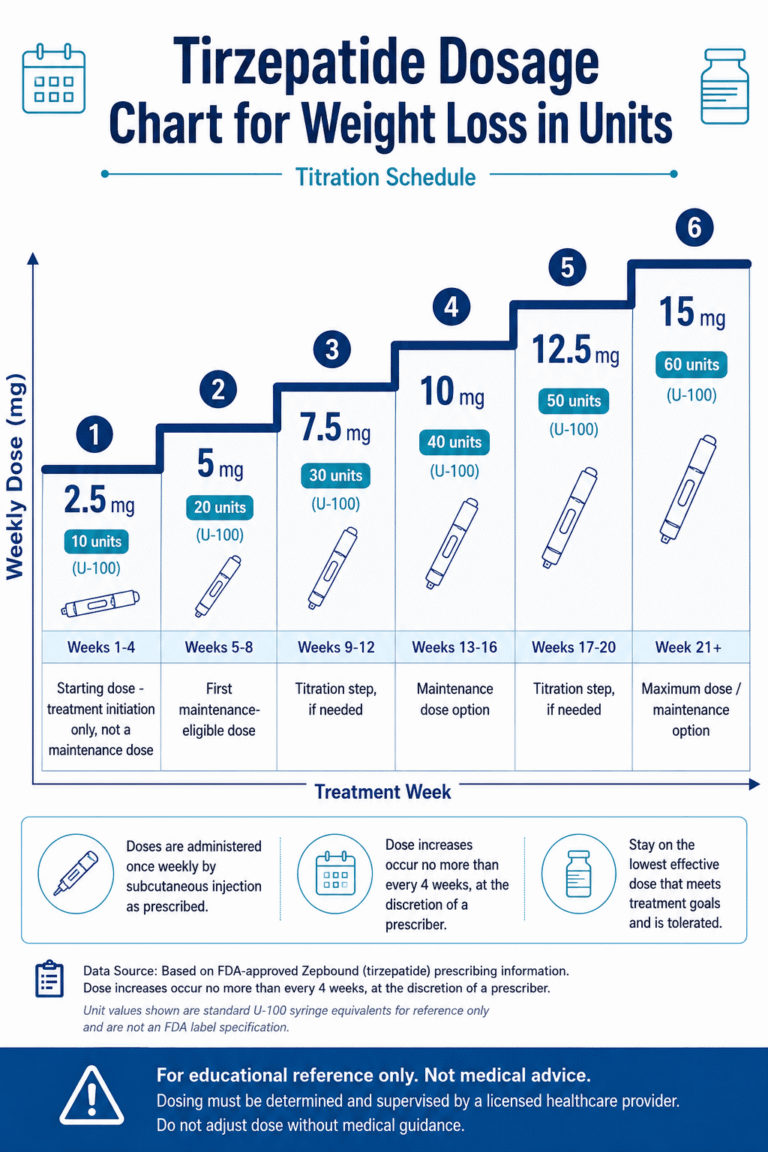
Tirzepatide Dosage Chart for Weight Loss in Units | Titration Schedule

Frequently Asked Questions

A peptide calculator also called a peptide dosage calculator, peptide reconstitution calculator, or peptide concentration calculator is a free online tool that helps researchers and clinicians determine the exact amount of solution to draw into a syringe for each injection. You select your vial size (mg), the volume of bacteriostatic (BAC) water added (mL), your desired dose (mg), and your syringe size. The tool calculates concentration, injection volume in mL, and syringe units automatically scaled to the syringe you’re actually using.

Peptide therapy is the use of specific peptides short chains of amino acids to target and influence physiological functions in the body. It works by changing or improving how certain parts of the body function, with peptides binding to receptors to trigger effects like growth hormone release, fat breakdown, muscle growth, and collagen production. It can be administered through injections, oral capsules, nasal sprays, or transdermal creams depending on the peptide used, and is generally considered safest when supervised by a doctor.

Peptides are short chains of amino acids the same building blocks that make up proteins. They’re basically short proteins, usually about 2 to 100 amino acids long. Your body naturally produces many peptides to carry out everyday biological functions. Peptides are mostly used for weight loss (GLP-1 drugs like Ozempic/Wegovy), skincare and anti-aging, muscle growth and recovery, and medical treatments like diabetes management.

A peptide serum is a concentrated skincare treatment formulated with peptides short chains of amino acids that act as cellular messengers in the skin. They work by sinking into the skin and sending signals that prompt it to repair itself and produce more collagen, the protein responsible for keeping skin firm and smooth. With regular use, peptide serums can stimulate collagen production, improve skin elasticity, strengthen the skin barrier, and reduce the appearance of fine lines and wrinkles, resulting in a firmer, smoother, more youthful-looking complexion.

To calculate peptide dosage without an online peptide calculator, follow this peptide injection math: (1) Find the concentration: mg/mL = vial mg ÷ BAC water mL. (2) Find draw volume: mL = dose (mg) ÷ concentration (mg/mL). (3) Convert to units: units = mL × 100, regardless of syringe size. This is the core peptide dosing guide used across clinical and research settings. Our free peptide calculator automates all three steps instantly and checks the result against your syringe’s capacity.

The amount of bacteriostatic water depends on your vial size, your target dose, and the syringe you plan to use. Common reconstitution volumes in peptide therapy dosage practice are 1 mL, 2 mL, or 3 mL. More BAC water creates a lower concentration, which means larger, easier-to-read syringe draws but it must still fit within your syringe’s capacity. Use our BAC water calculator to test different water volumes and syringe sizes together to see the resulting units instantly. For a 5 mg vial, adding 2 mL gives a 2.5 mg/mL concentration; a 0.5 mg dose would require drawing 20 units, which fits comfortably on a 30u, 50u, or 100u syringe.

The FDA has approved around 130 peptide drugs, though estimates vary by source (some count 80+). Peptides are short chains of amino acids that act as hormones or signaling molecules in the body, and FDA-approved peptide drugs fall into several major categories:

  • Metabolic & Weight Loss: GLP-1 receptor agonists: Semaglutide (Ozempic, Wegovy, and oral form Rybelsus) and Liraglutide (Victoza, Saxenda) regulate blood sugar and support weight loss. Dual GLP-1/GIP agonist Tirzepatide (Mounjaro, Zepbound) targets two receptors for enhanced blood sugar control and weight loss.
  • Bone & Endocrine Disorders: Teriparatide (Forteo) and Abaloparatide (Tymlos) stimulate bone formation for osteoporosis. Tesamorelin (Egrifta) treats HIV-associated lipodystrophy, while Octreotide (Sandostatin) and Lanreotide (Somatuline) manage acromegaly and neuroendocrine tumors.
  • Oncology: Leuprolide (Lupron) and Goserelin (Zoladex) are hormone-based therapies for prostate and breast cancer. Degarelix (Firmagon) is used for prostate cancer.
  • Gastrointestinal Conditions: Linaclotide (Linzess) and Plecanatide (Trulance) treat IBS and chronic constipation by acting on fluid secretion in the gut. Teduglutide (Gattex) promotes intestinal adaptation in Short Bowel Syndrome.
  • Central Nervous System & Pain Relief: Ziconotide (Prialt), a synthetic version of cone snail venom, treats severe chronic pain. Bremelanotide (Vyleesi) treats hypoactive sexual desire disorder in premenopausal women.
  • Rare Diseases & Diagnostics: Afamelanotide (Scenesse) increases pain-free light exposure for erythropoietic protoporphyria. Sincalide (Kinevac) and Octreotide-based imaging agents (Octreoscan) are used in diagnostic imaging. [1]

Yes. Peptides occur naturally in many protein-rich foods, since they’re simply short chains of amino acids the building blocks of protein. Foods that are good sources of peptides include meat, fish, shellfish, beans, lentils, soy, oats, flaxseed, hemp seeds, and wheat. When you eat these foods, your body breaks down their proteins into peptides and individual amino acids, which it then uses for tissue repair, hormone production, and other essential functions. [2]

Insulin-style syringes are commonly sized at 30 units (0.3 mL), 50 units (0.5 mL), and 100 units (1.0 mL) all marked so that 1 mL equals 100 units. Smaller syringes (30u, 50u) have unit lines spaced further apart, making low-volume draws easier to read precisely, but they hold less total liquid. If your calculated draw volume exceeds your syringe’s maximum, the calculator will flag it — you’d need a larger syringe or a more concentrated (less diluted) solution.

mg (milligrams) and mcg (micrograms) both measure mass 1 mg = 1,000 mcg. This calculator works in mg for all inputs. If your protocol specifies a dose in mcg, simply divide by 1,000 to convert before entering (e.g. 250 mcg = 0.25 mg). When following a peptide dosage chart, always confirm which unit the protocol uses before calculating.

Globally, peptide manufacturing labs and suppliers include a wide range of organizations that produce or distribute research peptides and related products. Some well-known names frequently referenced in the research community include Adipotide (research peptide), Arctic Peptides, Biolongevity Labs, Bluewell Peptides, Janoshik Labs (independent analytical testing laboratory), JPT Peptides, Peptide Sciences, QK Peptide (research peptide), XCE Peptides, and XPeptides. When evaluating any supplier, it’s important to review factors such as product documentation, third-party testing, Certificates of Analysis (COAs), quality-control practices, and compliance with applicable regulations. if you prefer Chinese companies, see you reference. [4]
Yes. This online peptide calculator works for any lyophilized peptide including BPC-157, TB-500, CJC-1295, Ipamorelin, GHK-Cu, Semaglutide, Tirzepatide, Retatrutide, MK-677, and others. The peptide reconstitution math is the same regardless of compound only the reference dose differs. Select your vial amount, BAC water volume, desired dose, and syringe size, and the calculator handles the rest.

After calculating, click the Share Result button. This copies a URL to your clipboard that encodes all your input values including syringe size as URL parameters. Anyone who opens the link will see the same calculator pre-filled with your exact inputs no account or sign-up required.

This free peptide calculator uses the exact same mathematical formulas published in pharmaceutical reconstitution references. The calculations are mathematically precise given the inputs you provide. However, this tool is intended for research and educational purposes only. Always consult a licensed healthcare professional before administering any peptide compound. Measurement accuracy also depends on your physical equipment (syringes, water volumes), not just the calculation.

Note: Peptide Calculator · Free peptide dosage calculator, BAC water calculator, and reconstitution tool for research use. Not medical advice.

Peptide Calculator - Featured on Startup Fame